
CASES · STRATEGY
Vision for a forum
The task: Civil society actors were to jointly establish a forum at the municipal and federal levels. In addition to providing modern spaces for their own work, the group needed to clarify what the added value, the common ground, and the shared vision for such a space might be—and how it could then function as an organization. And as is so often the case, the real question behind the substantive discussions became apparent relatively early in the process: Who actually gets to make decisions here?
The engagement
- Client Municipality
- Sector Public administration · civil society
- Period 2020 – 2021
- Involved Municipality · Federal Archives · civil society organisations
- Service Process support · strategy architecture · facilitation
THE PROCESS
Not as expected, but successfully settled.
1 The starting point
What is actually to be decided here?
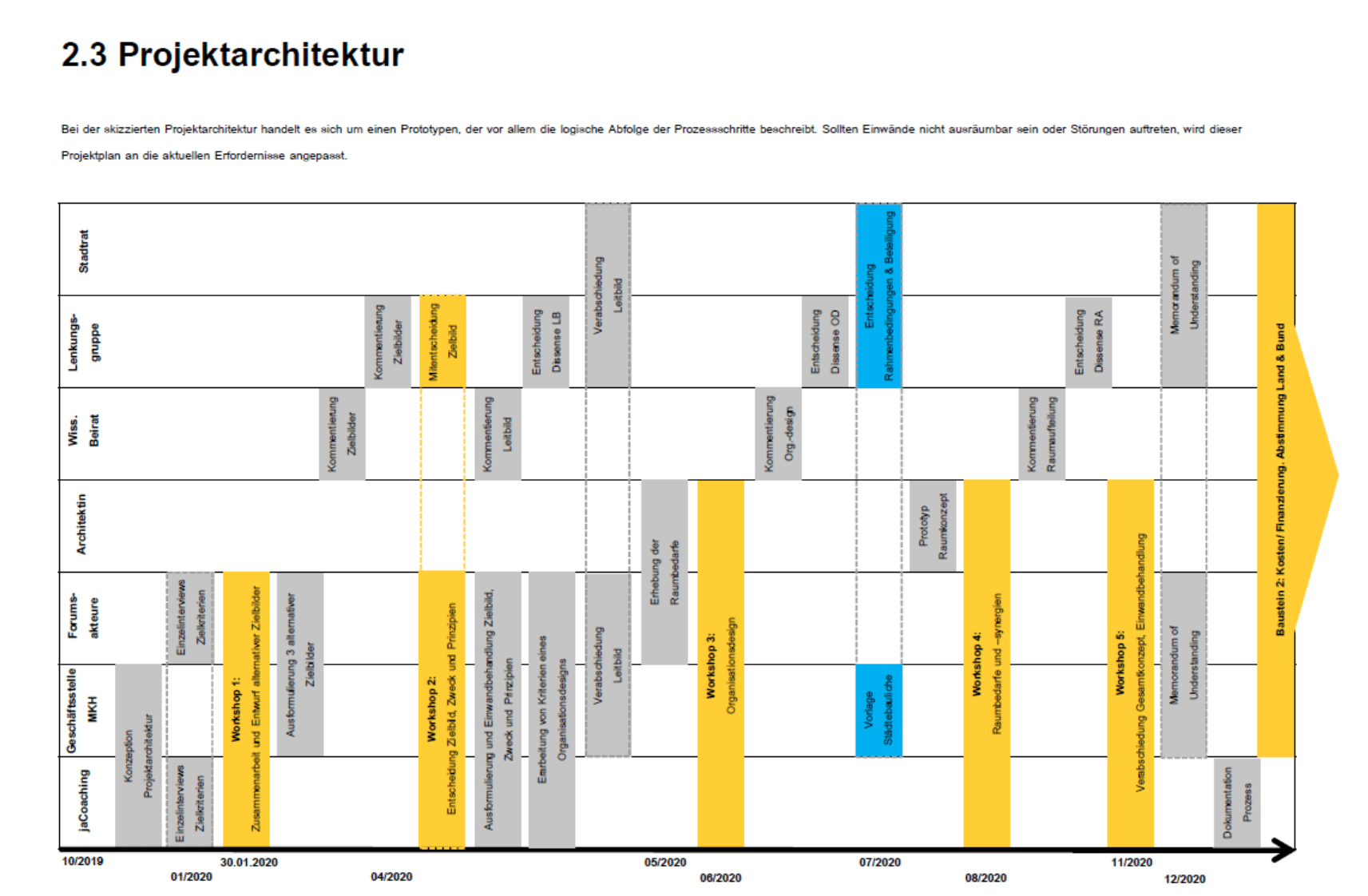
At first, the assignment seemed clear: Together, we were to develop a vision for the forum, derive an organizational design from it, and set both forth in a memorandum of understanding. At the same time, an architect assessed the space requirements and spatial relationships.
We initially viewed the assignment as a strategic process: clarifying a shared direction, deriving structures from it, and establishing a commitment. As the process unfolded, it became clear that the crucial question ran deeper.
2 The deadlock
Circular discussion.
In terms of content, the discussion seemed to center on the forum’s focus: Should the forum primarily be a place of remembrance or a place looking toward the future? The discussion revolved around the same question several times without reaching a decision.
As the process unfolded, it became increasingly clear that another issue lay beneath the surface: Where are the crucial decisions actually made—and what role does the municipality intend to play in the future forum?
3 The decision
What only leadership could decide.
In the end, the conflict could not be resolved among the parties involved. We therefore consolidated the outstanding issues into a decision tree for the commune’s leadership: Who manages the forum? Where are decisions made? And what role will the commune itself play in the future?
These decisions also clarified the organizational model: a space managed by the municipality where civil society actors can rent space and collaborate. The result did not meet everyone’s original expectations. But the decision had been made—and was therefore implementable.
FROM THE WORK
Systemic reading.
Conflicts over issues sometimes involve more than just their apparent substance. In this case, it was impossible to determine the substantive direction as long as it remained unclear who actually had the authority to make decisions, who was providing the funding, and what role the municipality intended to play.
When this decision-making framework became explicit, the differences in substance did not disappear. But they no longer had to be played out as a proxy for the unresolved organizational issue. The conflict became manageable—and a solution became possible that, while not meeting everyone’s expectations, was nonetheless achievable.
Dr. Jonas Asendorpf
MORE CASES
From public administration.


LET’S TALK